Machine Learning
What is Machine learning?
In the traditional programming approach, code was manually written to receive user input, process it, and generate output. The effectiveness of the program relied heavily on the skill with which it was crafted by the developer. It primarily served as a problem-solving algorithm for users and was perceived as a form of automation.
Machine Learning (ML) is an awe-inspiring field within the realm of Artificial Intelligence (AI). It involves the development of models that possess the remarkable ability to learn and enhance their performance through experience. This is accomplished by leveraging data collected from various sources, enabling the model to improve its own understanding and make more accurate predictions or decisions over time.
Difference between Traditional programming style and Machine Learning
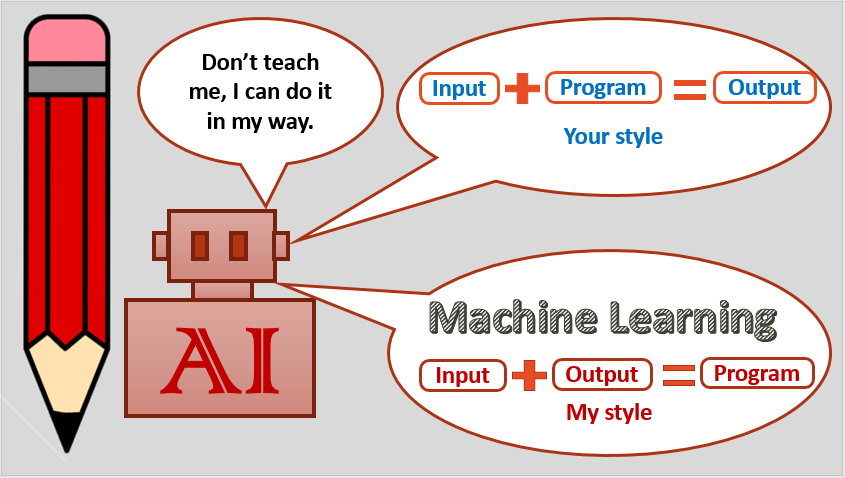
The general principle underlying most programs can be summarized as follows: taking input, performing a series of operations or processes, and generating the corresponding output.
Input + Process = Output (Traditional Programming Style)
In traditional programming style we used to write code manually which takes user input, process that and produces output. The whole model is depended on human, how smartly the program is written. It just served as a problem-solving algorithm for the end user and considered as an automation only.
Contrary to conventional programming, Machine Learning (ML) operates on a different principle: input data combined with corresponding output data leads to the development of a process or algorithm. In this approach, the system learns from the provided input-output pairs to create its own program or algorithm, much like how humans learn, comprehend, and adapt their behavior based on experience.
Input + Output = Process (Machine Learning Programming Style)
That means the system takes input data and as well as output data to develop its own new program or algorithm. Something like we human learn, understand and behave accordingly. Machine Learning (ML) empowers machines to autonomously uncover algorithms without relying on human intervention or guidance. Machine learning basically works by exploring data and identifying patterns and involves minimal human intervention.
Definitions of Machine Learning
IBM who coined the word “Machine learning” defines machine learning as a branch of artificial intelligence (AI) and computer science which focuses on the use of data and algorithms to imitate the way that humans learn, gradually improving its accuracy. – IBM
“Machine learning is the science of getting computers to act without being explicitly programmed.” – Stanford University
Machine Learning (ML) is something amazing, it is a branch of AI which creates a model that is capable of learning its own and improve from experience using the data collected from different sources.
We need to understand how we learn and grow from our childhood, we are trained by our Parents, Teachers initially, their after we ourselves improve upon past experience and don’t need Parent’s guidance at all. We learn by experience and create new strategies to deal with the problems and new challenges, so as to machine learning.
You may also like to read:





Leave a Reply